

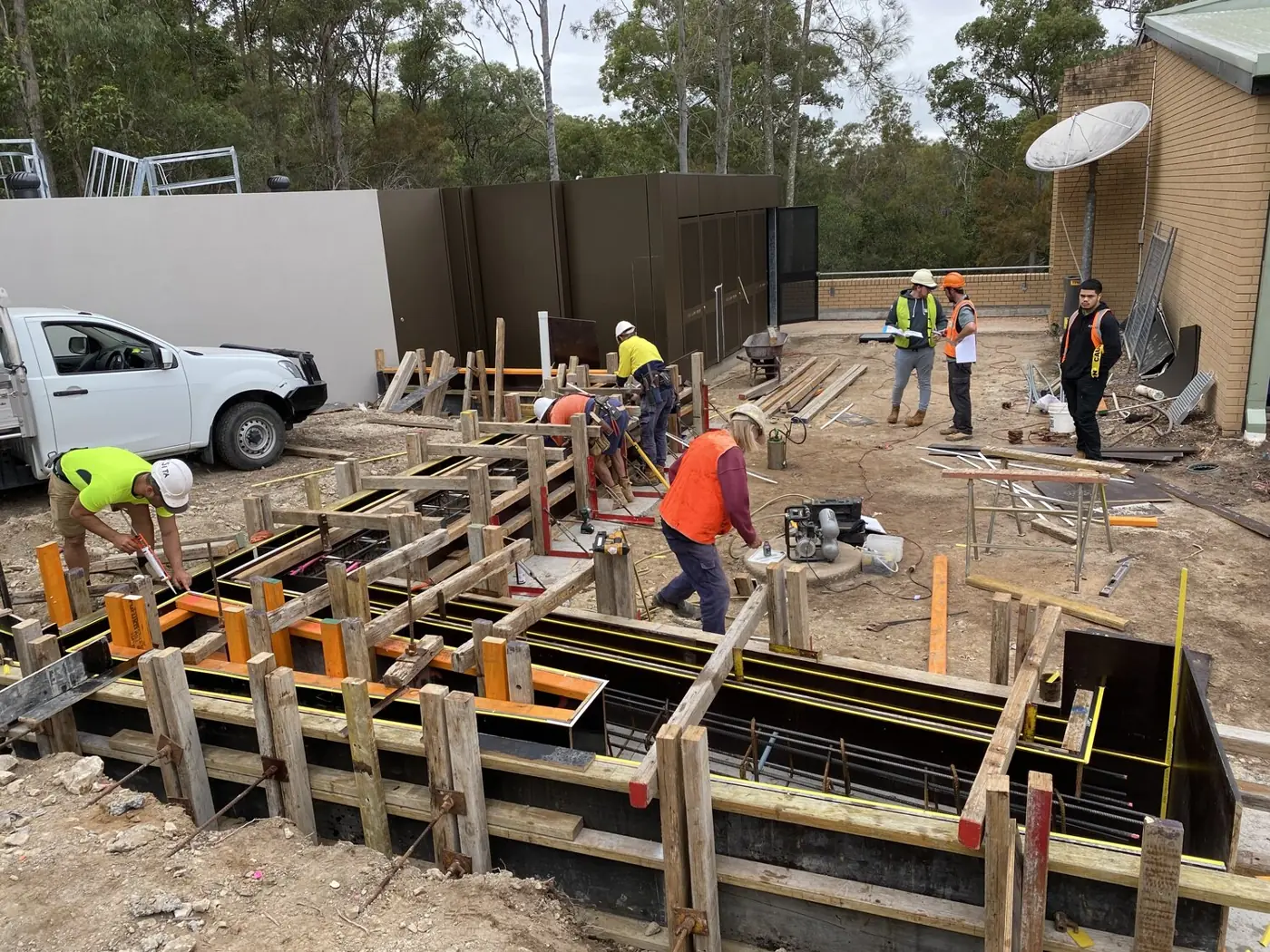
Most home driveways are about 100 mm thick with reinforcing mesh. Garden shed slabs are usually 75–100 mm. Larger sheds and garages are 100 mm or more with thickened edge beams, and heavy-vehicle driveways are 125–150 mm. The soil under the slab can change all of these, which is why anything that needs building approval gets an engineer's design.
Typical thickness by job
| Job | Typical thickness | Typical steel | Notes |
|---|---|---|---|
| Garden path | 75–100 mm | Light mesh | Control joints every 1.5–2 m |
| Garden shed (small) | 75–100 mm | Mesh | Level pad, falls away from the door |
| Driveway (cars) | 100 mm | SL72 or SL82 mesh | Thicker at the crossover if council requires |
| Driveway (caravan, boat, truck) | 125–150 mm | SL82 or heavier | Plan where heavy wheels will sit |
| Large shed or garage | 100 mm+ with edge beams | Mesh + beam steel | Engineer's design when approval is needed |
| House slab | Engineer's design | Per design | Set by the soil class and the building |
Typical figures for Queensland residential work. An engineer's design or council standard always takes priority. Confirm Josh's standard driveway spec (thickness, mesh, concrete grade).
Why the soil matters
Australian Standard AS 2870 (residential slabs and footings) sorts sites by how much the ground moves as it gets wet and dries out:
| Class | Ground | Where you'll often find it |
|---|---|---|
| A | Sand and rock, little or no movement | Beachside Gold Coast suburbs |
| S | Slightly reactive clay | Mixed coastal and inland sites |
| M | Moderately reactive clay | Many inland Gold Coast and Logan suburbs |
| H1 / H2 | Highly reactive clay | Parts of Logan and the hinterland |
| E | Extremely reactive clay | Isolated pockets |
| P | Problem sites: fill, soft ground, slopes | Anywhere, including filled estate lots |
The more reactive the clay, the deeper the edge beams and the more steel a slab needs. A shed slab that's fine on Palm Beach sand can crack on Park Ridge clay. For houses and approved sheds, a soil test sets the class. For driveways and paths we judge it on site and adjust the thickness, mesh and joint spacing. See concreting in Logan and the southern Gold Coast for how this plays out locally.
Mesh, strength and the layer underneath
- Mesh: SL72 and SL82 are standard square mesh sheets, with roughly 7 mm and 8 mm bars on a 200 mm grid. Mesh only works if it sits in the slab, not on the ground, so it goes on plastic bar chairs.
- Concrete strength: sold by its 28-day strength in megapascals. Residential slabs commonly use N20 to N25, and driveways N25 to N32 for a harder-wearing surface.
- Base: a compacted base under the slab matters as much as the concrete. Soft spots under a slab become cracks later.
- Vapour barrier: house slabs and enclosed garages go on a polythene membrane to stop ground moisture rising through the slab.
- Control joints: concrete shrinks as it cures. Saw-cut joints make it crack in a straight line where we choose, not randomly.
Does a shed slab need approval?
In Queensland, very small garden sheds are often exempt from building approval. Larger sheds, garages and carports generally need approval from a private certifier. That includes an engineer's footing and slab design, which tells us exactly how thick the slab and edge beams must be. Check with a certifier or your council before you order the shed kit. Kit suppliers usually provide the engineering when you buy an approved shed. Building work over $3,300 also needs a QBCC-licensed contractor. Our licence number is 1301879.