

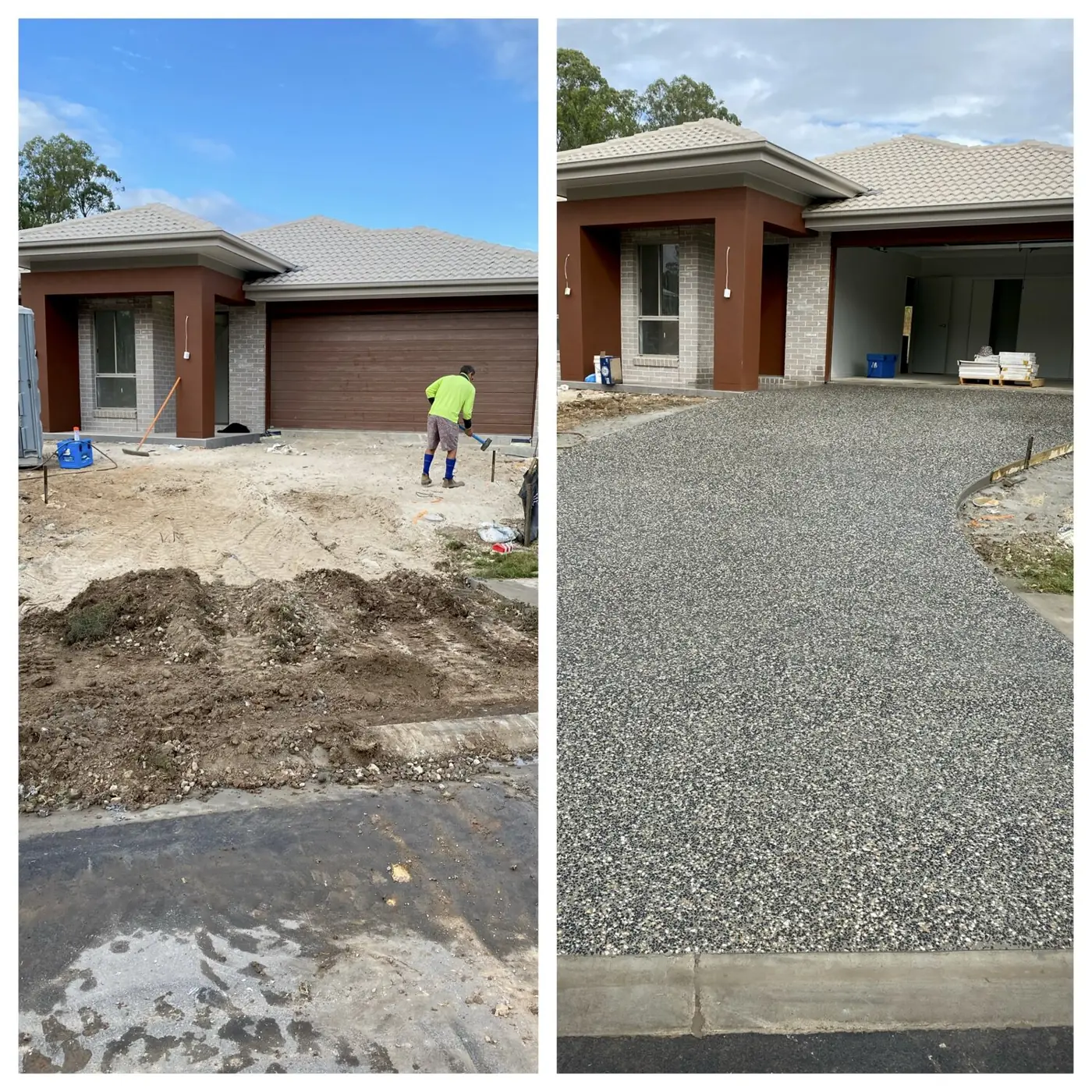
Walk on new concrete after 24–48 hours. Drive a normal car on it after about 7 days. Keep trucks, caravans, boats and skip bins off for 28 days. In Queensland's heat the surface goes hard quickly, but the strength underneath still needs time and moisture to build.
The timeline after a pour
| When | What's OK | Keep off |
|---|---|---|
| Pour day | Nothing. Let the crew finish and cure it. | Feet, pets, hoses, sprinklers |
| Day 1–2 | Careful foot traffic | Wheelbarrows, bikes, dragging furniture |
| Day 3–6 | Wheelie bins, bikes, foot traffic | Cars |
| Day 7 | Normal cars, parked away from edges | Heavy vehicles, sharp turns on the spot |
| Day 28 | Trucks, caravans, boats, skip bins, removalists | Nothing. It's at design strength. |
General guidance for standard residential concrete. Your crew will tell you if your mix or conditions change these times.
Why 7 days and 28 days?
Concrete doesn't dry out to get hard. It hardens through a chemical reaction between cement and water, called hydration, and that reaction keeps going for weeks. Strength builds fastest in the first week, and standard mixes reach most of their early strength by about day 7. That's enough for the weight of a car spread across four tyres.
Concrete is designed and tested at 28 days. When a slab is specified as N25 or N32, that's the strength in megapascals it must reach at 28 days. Heavy vehicles put big point loads on edges and joints, and those loads crack young concrete. So anything heavy waits the full four weeks.
How Queensland heat changes curing
On a 32-degree Gold Coast or Logan summer day, the top of a slab can go hard within hours. That's setting, not strength. If the surface loses its water too early, the reaction near the top stops, and you get:
- Plastic shrinkage cracks: fine, random surface cracks in the first few hours.
- A weak, dusty surface that wears and stains faster.
- Curling at edges and joints as the top dries faster than the bottom.
That's why our crew starts early on hot days. We keep the slab damp or apply a curing compound after finishing, and we don't pour in the heat of a summer afternoon. Confirm Josh's standard curing method (compound vs wet cure).
Five things that mark or crack a new driveway
- Parking on the edges. Edges are the weakest part of a young slab. Park in the middle for the first month.
- Skip bins and removalist trucks in the first 28 days. Book them for later, or have them stay on the street.
- Turning the steering wheel while stopped. It scuffs the surface, and on decorative finishes it leaves marks.
- Rubber mats, pot plants and steel furniture left on it. They can trap moisture and leave rings or rust stains.
- Pressure washing too early. Leave it for a month, then use a wide fan, not a narrow jet.
When should new concrete be sealed?
Decorative finishes like exposed aggregate and coloured concrete look best and last longest when sealed. The right time depends on the sealer: some go on after the first cure, others need the slab to dry out for weeks. We'll tell you which one we're using and when it goes on. After that, plan to reseal every few years to keep the colour rich and the surface protected. Confirm Josh's sealing timing.